 Today, July 16, 2010, marks the 65th anniversary of the beginning of the atomic age. It was on this date, at 5:29 a.m. local time in the desert near Alamogordo, New Mexico, that the United States Army Corps of Engineers under the military supervision of General Leslie R. Groves and scientific supervision of J. Robert Oppenheimer, detonated the first bomb powered by nuclear fission, a bomb code-named, in a moment of breathless military understatement, "the gadget." Ever since that "gadget" successfully detonated and the United States used two more over the cities of Hiroshima and Nagasaki, Japan, the atomic age has been one of fascination and revulsion the world over. The new super-energy attainable through the atom quickly went from revulsion in popular culture to sci-fi plot point magnet. And it was those early atomic age sci-fi films that prodded me along to become a bonafide sci-fi fanatic by my early teens. The Japanese were among the first to embrace nuclear energy in a science fiction setting with films like Gojira (Godzilla in its Americanized version) although not the first specifically, as films like War of the Worlds used atomic bombs within the story, if not as a method of creation like Gojira.
In was in that method, using atomic energy as a means of growing a monster, in literal form, that acted as catharsis for the Japanese viewing audience. And that catharsis was brought to them via legendary director Ishiro Honda. If you'd like to read more about the great Japanese sci-fi/fantasy director, you can do no better than these two articles, one by Kimberly Lindbergs at TCM's Movie Morlocks and the other by Mykal Banta of Radiation Cinema. In fact, Radiation Cinema is itself a wonderful resource for all the pop culture of the Atomic Age. Mykal stopped updating it in November but until he starts up again there is plenty to peruse at one's leisure. Also, while not specifically an atomic age article, this post by Richard Harland Smith at Movie Morlocks does touch on many of the same themes and includes some very important post-nuclear movies.
And while these atomic age sci-fi wonders nudged me in the direction of sci-fi, they didn't do anything for my interest in the age itself. That would come from history books, science books and fear of annihilation. Growing up during the Cold War between the United States and the Soviet Union, nuclear weapons were often at the forefront of conversation. My father had several history books in the house, including The Oppenheimer Case: Security on Trial, 1969, Philip Stern. I read through it, though as a small child I skimmed more than anything else. Still, there it was and of all the books my father had, including an invaluable set of encyclopedias dealing exclusively with American history, it was the one that caught my eye. It wasn't long before I was reading up on nuclear energy, SALT talks and philosophies like M.A.D. (Mutually Assured Destruction). I learned about Leo Szilard, Edward Teller, Enrico Fermi and Ernest Lawrence. I watched On the Beach, Dr. Strangelove and Fail Safe as many times as I could (thank you TBS for running them over and over and over). And when a new movie like The China Syndrome came out, I was the only kid in school who actually wanted to see it.
Then, late in high school, The Day After (d. Nicholas Meyer), with Jason Robards and JoBeth Williams, aired on ABC and it was a sensation. This was 1983 and the Cold War was at the boiling point. I watched the ABC movie with rapt attention and the next day the local news showed up at my high school to get
 student's reactions. Naturally, they were told by classmates to ask me, which they did. I got a lesson that day in how clever editing can make you look like a complete idiot. The reporter came to me to ask my reaction, thrust the mic in my face and I talked. And talked. And talked. I wouldn't shut up. I went on and on about the difference in conditions and results between Hiroshima and the destruction showed in the movie. I critiqued the footage of multiple bombs going off seemingly within a couple of miles of each other and saying how, given the yield of a thermo-nuclear warhead, the dispersal of heat and dozens of miles of fallout radius, this would be a waste of bombs and, in reality, the dispersal pattern would be much larger. Yes, I was a teenager. And that poor news crew discovered I was very anxious to show off how much I knew about the subject. I also threw in a criticism that not enough people died from radiation burns or sickness and that the movie seemed to focus on one or two characters getting slowly sicker where I felt that point should have been hammered home with much greater force.
After school I excitingly told my father and mother that I was going to be on the news, interviewed about The Day After! Oh my God, it was going to be glorious! The news came on and the three of us gathered round the tv to watch. The reaction to the movie was the lead story! Of course, there was a lot of reaction, from all over the country so the high school students' part was cut to mere seconds. I was a part of that mere seconds. About one second of it. There I was, front and center on the television saying simply, "Not enough people died." Anyone who didn't know me saw an idiot teenager who didn't like the movie because there wasn't enough bloodshed.
Other Cold War movies, like Wargames, were must-see events as well. I saw that one on opening weekend and as far as I'm concerned, it not only holds up but still has one of the best opening sequences to a thriller I've ever seen. However, for me, documentaries became the route to take because, while I enjoyed the thrillers and realistic fictions, it was the real story I wanted and that, in turn, led to my interest in documentaries over all. And while I have viewed many more documentaries on the subject of nuclear war than fiction films, not all have been satisfying. A documentary like The Atomic Cafe is excellent but too concerned at times with ridiculing the era rather than giving a real appreciation for the gravity of what was going on in the world during that time. To this day I meet younger people who have seen The Atomic Cafe and seem to have the impression that the Cold War was this really big silly-fest that went on in the fifties and sixties. It wasn't. It was serious, and frankly, pretty damn scary. I much prefer to direct people towards the documentaries
 and narrative films on the subject that I have reviewed here, including The Day After Trinity, Day One, Trinity and Beyond and Radio Bikini. Most of the original comments on those reviews are lost forever as I foolishly used Haloscan for comments here for the first year and a half and that system is now off the grid but if you'd like to comment on any of them, please, feel free. My friend Marilyn also has two excellent reviews of movies in this category, I Live in Fear and The House in the Middle, not a review proper but an interview with film preservationist Rick Prelinger that touches on the infamous nuclear civil defense film. Finally, Peter Nellhaus has a review of one of the best films ever made on the subject, Black Rain.
Today's date is a sobering one in human history and one that guided my interest in history and documentary filmmaking. It's a subject I don't think can be taken seriously enough and perhaps that is why, to some degree, I have always been a bit annoyed at criticisms that Fail Safe lost out to Dr. Strangelove because it took itself too seriously. No, it's just that Dr. Strangelove is one of the greatest films ever made but Fail Safe is still, nonetheless, an important and well-made film on the topic. I recommend both highly, as well as the documentaries listed above.
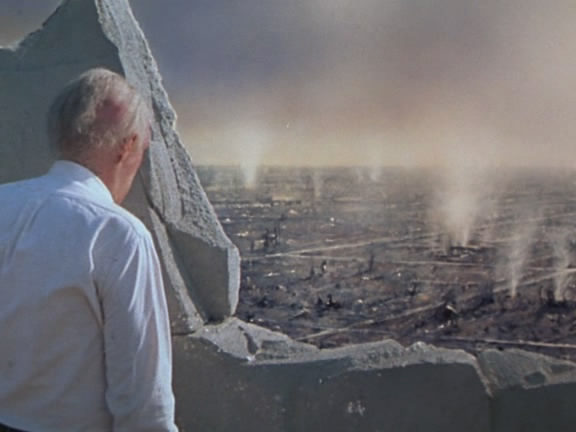
I close out with the trailer I made for the documentary The Day After Trinity two years ago. There was no actual trailer ever made for the film so I made one myself and put it up on YouTube. With nearly 12,000 views and three pages of comments, it's one of my more successful videos. The man at the start of the trailer, reading the letter he wrote to Oppenheimer, is Haakon Chevalier; the man looking distraught in the middle is Robert's brother Frank and the voice you hearing narrating the final part is physicist Freeman Dyson, not a Manhattan Project scientist but an integral part of the documentary, acting as the objective observer for most of it. It would be the documentary I would recommend the most as a start-up for anyone interested in the subject.


