
One thing many cinephiles and average movie goers alike rail against is "the happy ending." As in the Happy Ending of cliched legend, where everyone lives happily ever after and reality is thrown out the window. Of course happy endings have their place, but the thing is, while people rail against them, they don't realize most of their favorite movies have anything but an unhappy ending. They are not all over the top happy but few endings are complete downers. Most movies just end, as in the story is concluded. But this is already getting messy so let's step back and qualify.
Most cinephiles agree Alfred Hitchcock is near the top of the world's greatest filmmakers. And most cinephiles have gone off at one time or another about "the happy ending," and how hated it is. But how many Hitchcock films end staring into the stark face of despair? Not many. Vertigo's ending certainly isn't uplifting as Scottie walks to the ledge following Judy's death but it could be argued that with his vertigo and obsessions now gone, exorcised so to speak, perhaps he will finally get on with his life. I doubt it, but there's room there for argument.
And Psycho? Well, Vera Miles doesn't get killed, Norman gets caught and in the safe custody of the state, tips completely to the side of the Mother personality. It's not happy but it's not despairing either and provides closure. And how about Rear Window, Strangers on a Train, North by Northwest, Notorious, Shadow of a Doubt and many others? The guilty are caught, killed or punished, the heroes and heroines rescued and/or vindicated and in some cases, like Strangers on a Train, there's even a little joke thrown in at the end to send everyone home with a smile on their face. Many more Hitchcock's end this way, with a wink and a nod and an "all is right with the world again" philosophy (right up to his last, Family Plot), than don't.
And how about James Bond? The most successful series in film history with over twenty films and exactly one has a downer ending (On Her Majesty's Secret Service). Even Casino  Royale has a satisfying revenge ending after an initial downer but the ending of On Her Majesty's Secret Service is hopeless. And to me, despite thinking highly of the film as one of the best Bonds out there, feels rushed. I would have like a little more time devoted to Bond and Tracy, just a few more minutes, as husband and wife. Then the ending would have had much more impact.
And now we arrive at the real problem. The problem most of us have with a happy ending is the same problem we would have with a bleak ending that didn't work: We would dislike it if it didn't fit the story. It's not that it's happy or bleak, it's that it doesn't work. Both Ian Fleming and the producers of the film adaptation knew they didn't want Bond married, so both the book and film conclude with Tracy Bond's drive-by killing at the hands of Ernst Stavro Blofeld while George Lazenby as Bond struggles mightily with conveying the emotion of loss (and ultimately loses the struggle). It's an ending that not only feels wrong for this movie (and I know there are plenty of fans of this movie out there - please remember, I'm one of them) but feels wrong as an ending for a movie of this type in this particular franchise. I'm sure Fleming wanted to do something different, wanted to give Bond more depth or just a more complex history, but marrying him only to kill the bride feels like a cheap attempt to add gravitas to the series. [please see comments for further discussion of this]
Most movies find a way of combining despair and redemption for endings that satisfy both needs. One Flew Over the Cuckoo's Nest has despair in R.P. McMurphy's lobotomy and mercy killing by Chief Bromden but then redemption as Bromden escapes to freedom. On the Waterfront has Terry Malloy defeated and beaten but then redeemed as he leads a new work crew aboard the cargo ship. The Searchers has many shades of grey as Ethan (John Wayne) "rescues" Debbie (Natalie Wood) from her new life and returns her to her old providing despair, redemption and moral ambiguity rolled into one tight little package. And one writer whose article I read a while back even states that "happy endings" are more often not happy but affirming of the human spirit. He provides many examples of both happy and bleak endings including one of the bleakest of all, I am a Fugitive from a Chain Gang. With the Chain Gang ending now in the mix let's take it a step further.
Beyond fitting or not fitting the feel of a movie or its plot, the biggest difference between a good or bad happy/bleak ending is how long the director dwells upon it. In I am a Fugitive from a Chain Gang James Allen (Paul Muni) is an innocent man wrongly imprisoned and subjected to the brutality of the chain gang system in the South. By the end of the film he has escaped and survives by stealing, the false charge thrown on him in the first place. It works because it is expressed quickly and without histrionics. The audience gets it and "The End" flashes on the screen.
On the happy side, Dorothy (Judy Garland) awakens in the concluding scene of The Wizard of Oz to find everything is okay again. It's short and sweet and perfectly befitting of this charming children's tale.
But when those endings are dwelled upon, lingered over, problems arise. Take E.T. the Extra-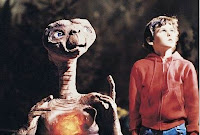 Terrestrial, a film I swear I never thought I'd bring up here. Providing that story with a happy ending makes perfect sense to me given the characters and plot. But oh how that ending is dragged out. In what feels like forever Elliot (Henry Thomas) and E.T. (voice of Debra Winger) say their goodbyes while John Williams' music reaches new levels of goopy ascendance. By the time E.T. says "I'll be right here" indicating he will always be in Elliot's heart this viewer starts to get angry. And if that overwrought sentimentality and hyper emotional piano playing isn't enough, the mother ship upon exiting makes a goddamn rainbow in the sky!!! Crikey! I admit this is one movie loved by many a cinephile with which I am at complete odds. I just don't get it. I find this kind of happy ending to be the kind that gives all other happy endings a bad name. Overdone, overwrought and beaten until dead.
And just when you thought I couldn't possibly annoy my fellow cinephiles any further I offer up as my example of a bleak ending going too far, The Godfather Part II. Now I am a fan of the Godfather movies. I'm not wild about the third one, but as unintentional comedies go, it's not bad (I can already feel the hate mail being written). However, even recognizing the superb filmmaking at work in Part II, I can't help but feel Coppola drags it out too long. Let's face it, there's almost no need for this film to exist in the first place as everything we need to know about Michael's moral downfall is made evident by the conclusion of the first film. The second film doesn't take his character any further than that final scene in the study from The Godfather, it just confirms that he is dead inside and his father was not. Three and a half hours is a long time for a simple elaboration on a point already made. Nevertheless, I like the film ... up to a point. By the time we get to Fredo being killed on the lake it feels as if the ending has been happening the whole movie. From the start we know Michael is a bastard and the second he discovers Fredo's betrayal we know he's going to have him killed. We watch with a sense of dread for what we know is inevitable. That's great and works extremely well. But then Coppola keeps emphasizing Michael's solitude, losing Kay, waiting in the boathouse at his mother's funeral, standing at the window while Fredo is killed and finally, and with a none too subtle visual stroke, alone on a bench in a dead, frozen landscape. It all feels like too much, like the director signalling, "Behold my courageous exploration of the human soul!" The Godfather Part II is an excellent sequel to the first but seems too enamored of its own sense of despair.
And then there are countless other examples of movies with happy or bleak endings that either take it too far or admirably restrain themselves. Too many to mention here but two of my favorites are:
Chinatown - Best bleak ending EVER. Quick, focused, stunning.
Dodsworth - Best happy ending EVER. Despite being made during the Production Code Era, Dodsworth leaves his wife to be with the woman he actually loves. And does it just when you think all is lost.
If you have favorites, happy or bleak, let me know. Or give me hell over some of my opinions expressed here. Either way, I'm just happy to be here for you, even when things look bleak.
*********
Ed. Note - One of the great things about blogging is interacting with people who read and disagree with what you wrote. In the comments I have had the opportunity to re-assess my feelings on the ending of On Her Majesty's Secret Service and have changed "tacked on" to describe the ending to "rushed" and have added a sentence of elaboration. I know many still disagree with that but "tacked on" was the wrong choice of words and didn't express what I was trying to say.


