Showing posts with label radio bikini. Show all posts

Friday, July 16, 2010

Post-Nuclear Cinema

Today, July 16, 2010, marks the 65th anniversary of the beginning of the atomic age. It was on this date, at 5:29 a.m. local time in the desert near Alamogordo, New Mexico, that the United States Army Corps of Engineers under the military supervision of General Leslie R. Groves and scientific supervision of J. Robert Oppenheimer, detonated the first bomb powered by nuclear fission, a bomb code-named, in a moment of breathless military understatement, "the gadget." Ever since that "gadget" successfully detonated and the United States used two more over the cities of Hiroshima and Nagasaki, Japan, the atomic age has been one of fascination and revulsion the world over. The new super-energy attainable through the atom quickly went from revulsion in popular culture to sci-fi plot point magnet. And it was those early atomic age sci-fi films that prodded me along to become a bonafide sci-fi fanatic by my early teens. The Japanese were among the first to embrace nuclear energy in a science fiction setting with films like Gojira (Godzilla in its Americanized version) although not the first specifically, as films like War of the Worlds used atomic bombs within the story, if not as a method of creation like Gojira.

In was in that method, using atomic energy as a means of growing a monster, in literal form, that acted as catharsis for the Japanese viewing audience. And that catharsis was brought to them via legendary director Ishiro Honda. If you'd like to read more about the great Japanese sci-fi/fantasy director, you can do no better than these two articles, one by Kimberly Lindbergs at TCM's Movie Morlocks and the other by Mykal Banta of Radiation Cinema. In fact, Radiation Cinema is itself a wonderful resource for all the pop culture of the Atomic Age. Mykal stopped updating it in November but until he starts up again there is plenty to peruse at one's leisure. Also, while not specifically an atomic age article, this post by Richard Harland Smith at Movie Morlocks does touch on many of the same themes and includes some very important post-nuclear movies.

And while these atomic age sci-fi wonders nudged me in the direction of sci-fi, they didn't do anything for my interest in the age itself. That would come from history books, science books and fear of annihilation. Growing up during the Cold War between the United States and the Soviet Union, nuclear weapons were often at the forefront of conversation. My father had several history books in the house, including The Oppenheimer Case: Security on Trial, 1969, Philip Stern. I read through it, though as a small child I skimmed more than anything else. Still, there it was and of all the books my father had, including an invaluable set of encyclopedias dealing exclusively with American history, it was the one that caught my eye. It wasn't long before I was reading up on nuclear energy, SALT talks and philosophies like M.A.D. (Mutually Assured Destruction). I learned about Leo Szilard, Edward Teller, Enrico Fermi and Ernest Lawrence. I watched On the Beach, Dr. Strangelove and Fail Safe as many times as I could (thank you TBS for running them over and over and over). And when a new movie like The China Syndrome came out, I was the only kid in school who actually wanted to see it.

Then, late in high school, The Day After (d. Nicholas Meyer), with Jason Robards and JoBeth Williams, aired on ABC and it was a sensation. This was 1983 and the Cold War was at the boiling point. I watched the ABC movie with rapt attention and the next day the local news showed up at my high school to get student's reactions. Naturally, they were told by classmates to ask me, which they did. I got a lesson that day in how clever editing can make you look like a complete idiot. The reporter came to me to ask my reaction, thrust the mic in my face and I talked. And talked. And talked. I wouldn't shut up. I went on and on about the difference in conditions and results between Hiroshima and the destruction showed in the movie. I critiqued the footage of multiple bombs going off seemingly within a couple of miles of each other and saying how, given the yield of a thermo-nuclear warhead, the dispersal of heat and dozens of miles of fallout radius, this would be a waste of bombs and, in reality, the dispersal pattern would be much larger. Yes, I was a teenager. And that poor news crew discovered I was very anxious to show off how much I knew about the subject. I also threw in a criticism that not enough people died from radiation burns or sickness and that the movie seemed to focus on one or two characters getting slowly sicker where I felt that point should have been hammered home with much greater force.
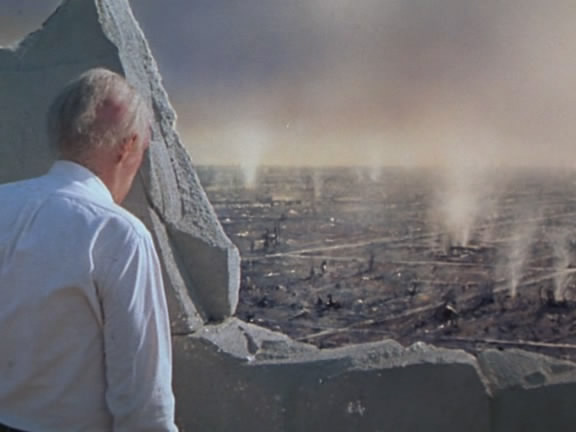
After school I excitingly told my father and mother that I was going to be on the news, interviewed about The Day After! Oh my God, it was going to be glorious! The news came on and the three of us gathered round the tv to watch. The reaction to the movie was the lead story! Of course, there was a lot of reaction, from all over the country so the high school students' part was cut to mere seconds. I was a part of that mere seconds. About one second of it. There I was, front and center on the television saying simply, "Not enough people died." Anyone who didn't know me saw an idiot teenager who didn't like the movie because there wasn't enough bloodshed.

Other Cold War movies, like Wargames, were must-see events as well. I saw that one on opening weekend and as far as I'm concerned, it not only holds up but still has one of the best opening sequences to a thriller I've ever seen. However, for me, documentaries became the route to take because, while I enjoyed the thrillers and realistic fictions, it was the real story I wanted and that, in turn, led to my interest in documentaries over all. And while I have viewed many more documentaries on the subject of nuclear war than fiction films, not all have been satisfying. A documentary like The Atomic Cafe is excellent but too concerned at times with ridiculing the era rather than giving a real appreciation for the gravity of what was going on in the world during that time. To this day I meet younger people who have seen The Atomic Cafe and seem to have the impression that the Cold War was this really big silly-fest that went on in the fifties and sixties. It wasn't. It was serious, and frankly, pretty damn scary. I much prefer to direct people towards the documentaries and narrative films on the subject that I have reviewed here, including The Day After Trinity, Day One, Trinity and Beyond and Radio Bikini. Most of the original comments on those reviews are lost forever as I foolishly used Haloscan for comments here for the first year and a half and that system is now off the grid but if you'd like to comment on any of them, please, feel free. My friend Marilyn also has two excellent reviews of movies in this category, I Live in Fear and The House in the Middle, not a review proper but an interview with film preservationist Rick Prelinger that touches on the infamous nuclear civil defense film. Finally, Peter Nellhaus has a review of one of the best films ever made on the subject, Black Rain.

Today's date is a sobering one in human history and one that guided my interest in history and documentary filmmaking. It's a subject I don't think can be taken seriously enough and perhaps that is why, to some degree, I have always been a bit annoyed at criticisms that Fail Safe lost out to Dr. Strangelove because it took itself too seriously. No, it's just that Dr. Strangelove is one of the greatest films ever made but Fail Safe is still, nonetheless, an important and well-made film on the topic. I recommend both highly, as well as the documentaries listed above.

I close out with the trailer I made for the documentary The Day After Trinity two years ago. There was no actual trailer ever made for the film so I made one myself and put it up on YouTube. With nearly 12,000 views and three pages of comments, it's one of my more successful videos. The man at the start of the trailer, reading the letter he wrote to Oppenheimer, is Haakon Chevalier; the man looking distraught in the middle is Robert's brother Frank and the voice you hearing narrating the final part is physicist Freeman Dyson, not a Manhattan Project scientist but an integral part of the documentary, acting as the objective observer for most of it. It would be the documentary I would recommend the most as a start-up for anyone interested in the subject.

Saturday, February 28, 2009

Poisoning Paradise


We all have dates in history that strike our attention once a year. Dates such as December 7th, November 22nd or September 11th. Dates that give us pause. Some dates mean more to one person than another. Some mean nothing at all to any but a very few. One of those dates, for me, is March 1st. Every year it swings around I stop and think about it. I don't bring it up but it's always there, on Wikipedia's "On This Day" entry but for those of us interested in the history of nuclear testing by this country, the Soviet Union, England, France and China no Wikipedia reminder is necessary. The date is the day the Castle Bravo event took place, local time, in the Marshall Islands. It was still February 28th in Washington, D.C. Castle Bravo was the detonation event of a dry fuel thermonuclear device, better known as a hydrogen bomb. In the parlance of nuclear testing, there is a series or operation name and a shot name. The series was Castle and included such shots as Romeo, Union and Bravo. Bravo was the biggest. And the most damaging.

It exceeded its expected yield by two and a half times. The reason it was so far off the mark is described well here but to long-story-short it, the physicists at Los Alamos failed to recognize that the lithium-7 isotope, thought to be inert, actually released neutrons as efficiently as the active lithium-6 isotope and boosted the fission of the uranium tamper by two and a half times. That fission process, which is only there to initiate the fusion process, ended up being responsible for 67 percent of the yield, while the fusion process produced only 33 percent.

But let's bring this down to human terms. According to a military official interviewed on Frontline in an episode in the eighties on testing, it was the first and only time the military and Atomic Energy Commission (AEC) got scared during a test. Observation ships more than 60 miles distant found themselves in danger when Bravo turned out to be not six megatons but fifteen. Crewmembers on observation ships were ordered below deck as fallout rained down for hours. The Marshall Islanders who had been evacuated to yet another new island found themselves being evacuated again, this time an emergency evacuation, as fallout created a snowstorm of radioactivity on their village. Adults and children unaware of what was going on began to taste the flakes and continued to drink the water that had become inundated. 65 miles away, in what should have been the safe zone, the Japanese fishing vessel, The Lucky Dragon #5, found itself in the path of fallout as well. By the time they returned to Japan three days later, everyone on board was in the throes of acute radiation sickness. One of the crew members died a few days later. So many tuna began turning up in the following weeks and months in Japan markets irradiated that the United States government had to reimburse Japan in the millions and apologize. The fact that the country in question was Japan only made matters worse.

Castle Bravo was a disaster. An absolute, unmitigated disaster.

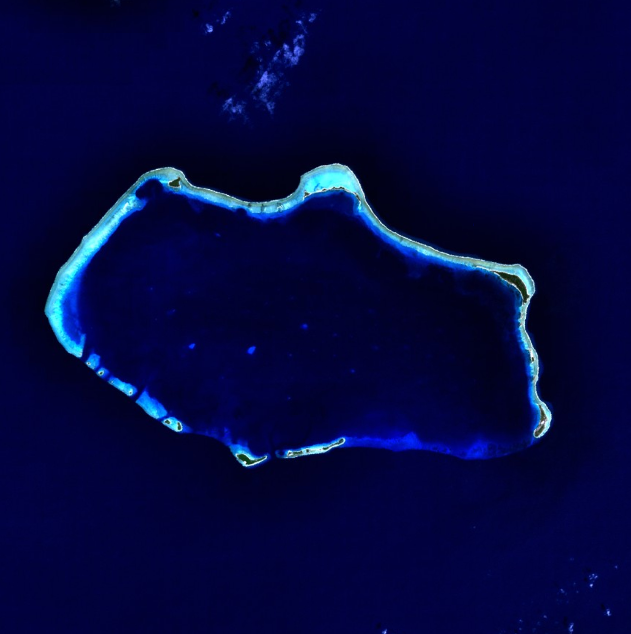
I have about ten documentaries on DVD concerning nuclear testing, the Manhattan Project or the destruction of Hiroshima and Nagasaki. None deal exclusively with Castle Bravo but one, Radio Bikini, does give a good idea of how poorly treated the Marshall Islanders were. Directed by Robert Stone, it uses no narration, simply providing government film footage interspersed with interviews of Kilon Bauno, the Chief of the Bikini Islanders and John Smitherman, an American G.I. assigned to Operation Crossroads, the first series of tests ever conducted at Bikini.

The islanders of Bikini were taken from their series of 36 islands forming a massive 229 square mile lagoon to a series of single islands where there was a scarcity of fresh water, food and without a lagoon, effectively no fishing. They were promised they would be moved back to their homes but with each new test and each new layer of radioactive debris the dates moved further and further back.

Radio Bikini details the relocations from the pie in the sky perspective of the government films, to the more cynical perspectives of Chief Bauno and John Smitherman. Bauno tells the sad tale of his people being relocated again and again until finally they were at home nowhere and accepted by no one. Smitherman speaks of going directly to ground zero, shown in the archival footage as dozens of G.I.s in nothing but t-shirts and shorts walked around the irradiated remains of the ships blasted by shot Abel and shot Baker of Operation Crossroads just days after the blasts had occurred. Throughout the documentary Smitherman is shown in close-up and we suspect it is because a reveal will occur late in the film. It does of course, and we see Smitherman's grotesquely swollen hand as he sits in a wheel chair, his legs having been amputated due to their swelling to the point of endangering his life. At the time of the documentary, 1987, the government had not yet taken responsibility for the medical problems of its Atomic Veterans. Even after finally taking responsibility with the passage of the Radiation Exposure Compensation Act, passed in 1990, the government continued to run studies that showed no link between the tests and the cancers that later developed. In these studies, some conducted as late as 1997, all 40,000 participants in the tests (the overwhelming majority never venturing near ground zero) were used and when the number of participants who developed cancer was shown to be statistically insignificant they smugly concluded there was no connection. When filmmakers and writers like Robert Stone, Richard Miller, Harvey Wasserman, Norman Solomon, Robert Alvarez and Eleanor Walters did comparisons of ONLY those who went into the ground zero area, well... I probably don't have to tell you that the number who died from cancer was not statistically insignificant.

But the Act did pass. The details of compensatory payment in the Act, from the Atomic Veterans Website , are as follows:


Onsite Participant - $75,000
Downwinder - $50,000
Ore Transporter - $100,000

The Act also established a presumed connection between service on the tests and certain types of cancers, listed below. This was an important step on the part of the government. This made the act unambiguous. If you were an onsite participant and developed one of these cancers, it would be presumed to come from the test, no questions asked:

leukemia (except chronic lymphocytic leukemia)
multiple myeloma
lymphomas (except Hodgkin's disease)
liver (unless cirrhosis or hepatitis B is indicated)
thyroid
breast
esophagus
stomach
pancreas
pharynx
small intestine
bile ducts
gall bladder
urinary tract
salivary gland


As for the Bikini Islanders, here's the relevant quote on the matter from Wikipedia:


"In 1968 the United States declared Bikini habitable and started bringing a small group of Bikinians back to their homes in the early 1970s as a test. In 1978, however, the islanders were removed again when strontium-90 in their bodies reached dangerous levels after a French team of scientists did additional tests on the island. It was not uncommon for women to experience faulty pregnancies, miscarriages, stillbirths and damage to their offspring as a result of the nuclear testing on Bikini. The United States provided $150 million as a settlement for damages caused by the nuclear testing program."


Radio Bikini is under an hour long and readily available on Netflix. I recommend giving it a look. It came out a few years after The Atomic Cafe and is a welcome counterpoint in mood to that documentary, an excellent film no doubt but filled with a bit too much snark and irony to really hit the point home of the horrors of nuclear testing. Besides, its point is mainly how the government went to ridiculous measures to reassure us that everything was okay. And it succeeded very well. But Radio Bikini takes on the other side of the story. The story of suffering, of pain and loss and gross negligence. It is straight forward and sobering. It was 55 years ago today that Castle Bravo further poisoned the Marshall Islands. The remaining inhabitants and their descendants still haven't returned home.


_________________________________
_________________________________


Below is a four minute segment on the Castle Bravo event from the documentary Trinity and Beyond (1997) directed by Peter Kuran and narrated by William Shatner. The clip gives the date February 28, 1954. It was detonated at 6:45 a.m., March 1, 1954, local time, which made it the afternoon of February 28th, Washington D.C. time. My review of Trinity and Beyond is here.