 As Footloose taught the world, there is a time for everything. I spend most of my time here deconstructing movies in one way or another in an effort to continually better my understanding of them and, as a result, watch movies with a sharper, more discerning eye than I ever did in my cinematic infancy. But sometimes I just don't have time for that 'cause I'm too busy thinking, "That is one badass mutha fucka!" So alert Kevin Bacon, because it's October and that means it's time for some shout-outs to my favorite BAMFs of horror and sci-fi!
Now this won't be a list per se, more a haphazard collection of thoughts on some of my favorite BAMFs in the horror/sci-fi universe that kind of, sort of forms a list-like thing. Plus, there's no rules. Sometimes it's a character, played by multiple actors, sometimes it's a particular actor playing a particular character. Sometimes it's lead, sometimes supporting. I guess the only thing I'm going to purposely avoid are the characters that are written as badasses, you know, the Vin Diesel or Arnold Schwarzenegger types or what Ripley became to the Alien series. Ah, hell, let's just get started?
 - The BAMF that got me thinking up this whole thing in the first place is Peter Cushing as Doctor Van Helsing. Now this is a perfect example of what I'm talking about because Van Helsing's been played a million times, from Edward Van Sloan's unflappable Nosferatu obsessive in the original adaptation of the stage play of Dracula (1931) to Anthony Hopkin's rather loud and excitable vampire hunter in Bram Stoker's Dracula (1992). But nobody, and I mean nobody, got Van Helsing as undead-on right as Peter Cushing.
When you watch Cushing at work in Horror of Dracula or Brides of Dracula, you see an actor at the top of his form, yes, but also an actor who understands the character he's playing better than anyone else before or since. When it comes to playing Van Helsing, Cushing really is the smartest guy in the room. He's got the analytical side, the blood-vengeance side and, above all, the cool-in-the-face of terror side that makes his Van Helsing the best there is to offer. Take away his hammer, stake and crucifix and this mutha will grab a pair of candlesticks, construct a makeshift cross and bring the curtains down, literally, to do away with your sorry blood-sucking ass. Bite him on the neck and leave him for undead and guess what? He's going to whip out some holy water and a hot iron and burn your filthy disease right out of his body while another couple of vampires look on in stunned amazement. When all's said and done, there's no doubt about it: Peter Cushing's Van Helsing in one Bad Ass Mutha Fucka!
 - Now for a character from a series of movies I usually give a pretty hard time here at Cinema Styles: Obi-Wan Kenobi in the Star Wars Saga. Now, it's true, I got my problems with the saga overall but there's no questioning old Ben Kenobi's official BAMF status. And for the purposes of this inclusion please understand, I'm not talking expanded universe, I'm talking about the movies that were released. So I don't really care if there's some bigger bad-ass in Jedi Exile: The Journey to Malachor V or if something that happens in the movies is explained away in The Great Sith Encasement, Episode 17. Really, it's not possible for me to give even two shits less than I already do on that front. But Kenobi in the movies is number one, unquestionably.
When Darth Maul takes down everyone who stands in his way, including Kenobi's own mentor Qui-Gon Jinn, Kenobi leaps up from a prone position, grabs his saber in mid-air and slices the Sith shitheel in half. Anakin Skywalker, darkside Jedi at the height of his powers? Ha, ha, that's funny, because while Anakin can kick everyone's ass, from Count Dooku to an entire village of sand people, he can't do shit to Obi-Wan. In fact, when Anakin attempts a leap-in-the-air-from-prone-position finisher like Obi-Wan did with Darth Maul, he gets the legs cut out from under him, literally, and an arm too, just for good measure. Years later, an old Obi-Wan doesn't even break a sweat holding off Anakin, now Darth Vader. It takes Luke giving in to his anger to defeat Vader in Return of the Jedi but Obi-Wan? Sheeee-it, he not only dies of his own choosing but - and think about this - has the situation so under control he can actually take the time to look over at Luke, and mull it over first(!), while in the middle of a lightsaber duel with Vader! Obi-Wan Kenobi - Bad Ass Mutha Fucka!
 -Next up, Rosemary Woodhouse from Rosemary's Baby. Yeah, yeah, I know, you're thinking, "Don't you mean Sarah Connor from The Terminator or Ripley from Alien?" No, I don't. See, they're like the Diesel/Schwarzenegger characters, as in, prepackaged badasses, even if theirs were quite a bit better rendered than any Diesel or Schwarzeneggar characters ever were. Besides, you know how every now and then you stumble upon (usually by, in fact, using StumbleUpon) some list of the top ten this or that in the movies and the lists always suck because their choices are SO FUCKING OBVIOUS! That's because they're written by and for idiots who have no real connection to the movies or understanding of dramatic conflict. Well, guess what? Those guys would put Ripley and Connor on their list of badasses and for Star Wars, they'd list Vader, not Obi-Wan. Whew... so, back to Rosemary.
Rosemary's a badass because, in the end, she takes control and doesn't look back. Her husband, her doctor and seemingly every member of the AARP do their level best to marginalize her out of existence but when it comes time to walk the walk, Rosemary does a full-on strut! Keep in mind, this is a woman who was roofied by Satan and had her baby stolen by the Beelzebub Chapter of the Boynton Beach Club and she still has enough guts to 1) yell at everybody for what they did to her baby, 2) shove Roman's lies right back in his face ("Shut up. You're in Dubrovnik, I can't hear you.") and 3) in the middle of listening to a bunch of old witches bitch about how she's unfit, pick that baby right up and say, "Fuck it! It's here, it's mine and I'm taking care of it." She owns the situation and everyone present. Only one thing left to say: Bad Ass Mutha Fucka!
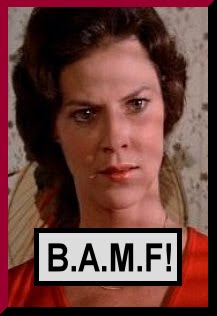 - And speaking of mothers, how about Diane Freeling in Poltergeist? Seriously, think about how much she does in that movie. First, she handles the loss of a pet with aplomb. Second, she's naturally curious, not scared, of the strange phenonemon taking place in her house. And on top of that, she never looks exhausted and worn out like hubby Steve Freeling does even though she's handling much more. When her daughter gets taken she bucks up, brings in people to explain the options and stands at the fore (remember when the ghosts start descending the stairway and she's right there, ready to go up those stairs to meet them?). When someone has to go into the void to get their daughter, Steve says he'll do it but she gives him some malarkey about how they need him to hold the rope and yadda, yadda, yadda. We all know the real reason is because he'd fail. Here's why (and I say this in all seriousness): Once, at work, I heard two people talking, one of them complaining about a seemingly impossible series of tasks that would have required either several people or one person with eight arms. That's when the other one said, "A mother could do it." She was, of course, a mother. That was before I was with my wife and our children but now that I am let me just say, "Yup."
So anyway, she goes in, gets her daughter and comes back out. Later, the gates to hell relocate to the closet in the kids' bedroom and Diane is thrown against the floor, walls and ceiling of her bedroom to prevent her from reaching her kids. She gets out. Then, the hallway elongates to the point where running gets her nowhere. But she keeps running anyway and eventually, she gets out of that one too. Then, when she swings the door open to the kids' room she damn near gets sucked in to a full-fledged vortex. But she doesn't. Know what she does? With one arm on the door frame and one arm holding onto her kids against 200 mile-per-hour sucking winds, she pulls those goddamn kids out, that's what she does. And I didn't even mention the monster in the hall, the corpses in the pool or the completely useless idiot neighbor. Diane Freeling gets everybody out to safety, no exceptions. After doing all the dirty work all hubby Steve has to do is get everyone in the car and drive them to a motel. Lucky for him his wife is one Bad Ass Mutha Fucka!
 - Let's top out our first five with Father Damien Karras in The Exorcist. Karras is different kind of badass because everything that makes him a badass comes as the final culmination of taking one flying turd in the face after another. Damien Karras is a priest the world has decided to shit on, daily. He's stressed out and broke, has to go to New York weekly, from Washington, D.C., to take care of his ailing mother, then deal with her being in a horrible nursing home until she dies alone and depressed while he's 300 miles away. If that weren't bad enough, he's brought into a bad situation with a demon-possessed girl who insists on vomiting on him when he asks her to back up what she's saying about his dead mother. And through it all, he follows the rules. He does his duty, to a fault. He psychoanalyzes and when that doesn't work he goes to the church and asks for special permission to conduct an exorcism. When he's told "No, but you can assist this old bastard we know who'll run the show," he doesn't complain. When he tries to fill the old guy in on what they're about to walk into ("The demon seems to have three distinct personalities") he's rudely cut off ("There is only one!"). While most of us would respond with, "Hey, fuck you, I'm just trying to help," old Damien keeps quiet. When he walks in the room and the demon looks like mom and he yells "You're not my mother!" and starts crying and the old guy says to leave, he does.
But then, when he comes back in and the old guy's dead and the demon possessed girl is on the bed, giggling, brother, he's done! He's tried talk. He's tried following church procedure. He's tried doing what the old guy says. And now, finally, Karras' true badass self emerges as he quietly says in his head, "Man, fuck it, it's clobbering time!" What follows must surely be the only time in cinematic history that the sight of a grown man viciously pummelling the face of a 12 year old girl is not only welcome, but encouraged. But that wouldn't make Karras a badass of the Mutha Fucka variety. No, you know what it is that does that, right? It's when he makes his whole goddamn life worthwhile in one single instant by saying to the demon, "Come into me! Take me!" He's saving the girl and sacrificing himself at the same moment. People, that's not just a hero, that's a Bad Ass Mutha Fucka!
And that's it for now. Sure there are millions more I could have done but I'm hoping these were the less obvious choices than, say, Taylor from Planet of the Apes (although I in no way deny his status as a fully licensed BAMF). Also, another non-obvious runner-up: Dave Bowman from 2001: A Space Odyssey. HAL kills everyone on board and then tells a stranded Dave that he isn't going to open that pod bay door and that Dave is screwed because he doesn't have his helmet so he can't come in manually. And you know what Dave does? He comes in manually anyway, without a helmet, and takes HAL apart! After that he follows his own destiny to beyond the infinite and becomes the star child who will provide the next step in our intellectual evolution. Awww, fuck yeah!
And so I leave you with dreams of your own favorite BAMFS of sci-fi and horror. To paraphrase the immortal words of Mr. Bacon, there is a time to laugh and a time to weep, a time to mourn and there is a time for BAMFs. Everybody dance!


