Showing posts with label 2001: A Space Odyssey. Show all posts

Tuesday, December 7, 2010

It occurs to me...

... a big disappointment, movie-wise, doesn't have to necessarily be a movie that had any chance of being good in the first place, or even a sequel to a good movie. Everyone mentions The Godfather, Part III as being a noteworthy disappointment but I'll be honest: I was much more disappointed in Beyond the Poseidon Adventure and that wasn't even a sequel to a very good movie to begin with.

After seeing The Towering Inferno, and liking it, I had high hopes for Earthquake. Boy, did that suck, bad!

Here's another one: The Wasp Woman. Yeah, yeah, I know, how could I have expected that to be good but that's missing the point. It's not that I expected it to be good, it's that I expected to be entertained, and I wasn't.

It also occurs to me that a movie that doesn't disappoint doesn't have to be good either. Like At the Earth's Core. Man, that still doesn't disappoint me. And I'm the first to admit, it's no 2001: A Space Odyssey.

Speaking of which, 2010: The Year We Make Contact. That disappointed, hugely. And I did expect it to be good! What a fool I was.

But Logan's Run and Raise the Titanic didn't disappoint, and lordy, that second one really should've but, you know, the ship came up real nice-like and that's all I paid to see anyway. And Logan's Run has all those cats and ivy in the nation's capitol. I mean, really, if I could cover Washington, D.C. in anything, it'd probably be cats and ivy so, kudos to the filmmakers for hitting the nail on the head there.

I should end this by saying big studio Oscar bait movies rarely disappoint because I expect them to be cliche-filled garbage and, sure enough, they usually are. So when you take in one of those and it sucks, it's expected. But a bad movie you expect to entertain you that doesn't? Brother, that can be crushing.

Saturday, October 9, 2010

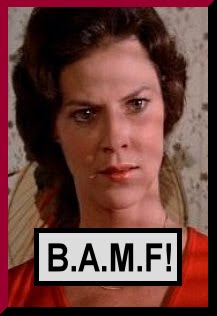
A Time for BAMFs

As Footloose taught the world, there is a time for everything. I spend most of my time here deconstructing movies in one way or another in an effort to continually better my understanding of them and, as a result, watch movies with a sharper, more discerning eye than I ever did in my cinematic infancy. But sometimes I just don't have time for that 'cause I'm too busy thinking, "That is one badass mutha fucka!" So alert Kevin Bacon, because it's October and that means it's time for some shout-outs to my favorite BAMFs of horror and sci-fi!

Now this won't be a list per se, more a haphazard collection of thoughts on some of my favorite BAMFs in the horror/sci-fi universe that kind of, sort of forms a list-like thing. Plus, there's no rules. Sometimes it's a character, played by multiple actors, sometimes it's a particular actor playing a particular character. Sometimes it's lead, sometimes supporting. I guess the only thing I'm going to purposely avoid are the characters that are written as badasses, you know, the Vin Diesel or Arnold Schwarzenegger types or what Ripley became to the Alien series. Ah, hell, let's just get started?

- The BAMF that got me thinking up this whole thing in the first place is Peter Cushing as Doctor Van Helsing. Now this is a perfect example of what I'm talking about because Van Helsing's been played a million times, from Edward Van Sloan's unflappable Nosferatu obsessive in the original adaptation of the stage play of Dracula (1931) to Anthony Hopkin's rather loud and excitable vampire hunter in Bram Stoker's Dracula (1992). But nobody, and I mean nobody, got Van Helsing as undead-on right as Peter Cushing.

When you watch Cushing at work in Horror of Dracula or Brides of Dracula, you see an actor at the top of his form, yes, but also an actor who understands the character he's playing better than anyone else before or since. When it comes to playing Van Helsing, Cushing really is the smartest guy in the room. He's got the analytical side, the blood-vengeance side and, above all, the cool-in-the-face of terror side that makes his Van Helsing the best there is to offer. Take away his hammer, stake and crucifix and this mutha will grab a pair of candlesticks, construct a makeshift cross and bring the curtains down, literally, to do away with your sorry blood-sucking ass. Bite him on the neck and leave him for undead and guess what? He's going to whip out some holy water and a hot iron and burn your filthy disease right out of his body while another couple of vampires look on in stunned amazement. When all's said and done, there's no doubt about it: Peter Cushing's Van Helsing in one Bad Ass Mutha Fucka!

- Now for a character from a series of movies I usually give a pretty hard time here at Cinema Styles: Obi-Wan Kenobi in the Star Wars Saga. Now, it's true, I got my problems with the saga overall but there's no questioning old Ben Kenobi's official BAMF status. And for the purposes of this inclusion please understand, I'm not talking expanded universe, I'm talking about the movies that were released. So I don't really care if there's some bigger bad-ass in Jedi Exile: The Journey to Malachor V or if something that happens in the movies is explained away in The Great Sith Encasement, Episode 17. Really, it's not possible for me to give even two shits less than I already do on that front. But Kenobi in the movies is number one, unquestionably.

When Darth Maul takes down everyone who stands in his way, including Kenobi's own mentor Qui-Gon Jinn, Kenobi leaps up from a prone position, grabs his saber in mid-air and slices the Sith shitheel in half. Anakin Skywalker, darkside Jedi at the height of his powers? Ha, ha, that's funny, because while Anakin can kick everyone's ass, from Count Dooku to an entire village of sand people, he can't do shit to Obi-Wan. In fact, when Anakin attempts a leap-in-the-air-from-prone-position finisher like Obi-Wan did with Darth Maul, he gets the legs cut out from under him, literally, and an arm too, just for good measure. Years later, an old Obi-Wan doesn't even break a sweat holding off Anakin, now Darth Vader. It takes Luke giving in to his anger to defeat Vader in Return of the Jedi but Obi-Wan? Sheeee-it, he not only dies of his own choosing but - and think about this - has the situation so under control he can actually take the time to look over at Luke, and mull it over first(!), while in the middle of a lightsaber duel with Vader! Obi-Wan Kenobi - Bad Ass Mutha Fucka!

-Next up, Rosemary Woodhouse from Rosemary's Baby. Yeah, yeah, I know, you're thinking, "Don't you mean Sarah Connor from The Terminator or Ripley from Alien?" No, I don't. See, they're like the Diesel/Schwarzenegger characters, as in, prepackaged badasses, even if theirs were quite a bit better rendered than any Diesel or Schwarzeneggar characters ever were. Besides, you know how every now and then you stumble upon (usually by, in fact, using StumbleUpon) some list of the top ten this or that in the movies and the lists always suck because their choices are SO FUCKING OBVIOUS! That's because they're written by and for idiots who have no real connection to the movies or understanding of dramatic conflict. Well, guess what? Those guys would put Ripley and Connor on their list of badasses and for Star Wars, they'd list Vader, not Obi-Wan. Whew... so, back to Rosemary.

Rosemary's a badass because, in the end, she takes control and doesn't look back. Her husband, her doctor and seemingly every member of the AARP do their level best to marginalize her out of existence but when it comes time to walk the walk, Rosemary does a full-on strut! Keep in mind, this is a woman who was roofied by Satan and had her baby stolen by the Beelzebub Chapter of the Boynton Beach Club and she still has enough guts to 1) yell at everybody for what they did to her baby, 2) shove Roman's lies right back in his face ("Shut up. You're in Dubrovnik, I can't hear you.") and 3) in the middle of listening to a bunch of old witches bitch about how she's unfit, pick that baby right up and say, "Fuck it! It's here, it's mine and I'm taking care of it." She owns the situation and everyone present. Only one thing left to say: Bad Ass Mutha Fucka!

- And speaking of mothers, how about Diane Freeling in Poltergeist? Seriously, think about how much she does in that movie. First, she handles the loss of a pet with aplomb. Second, she's naturally curious, not scared, of the strange phenonemon taking place in her house. And on top of that, she never looks exhausted and worn out like hubby Steve Freeling does even though she's handling much more. When her daughter gets taken she bucks up, brings in people to explain the options and stands at the fore (remember when the ghosts start descending the stairway and she's right there, ready to go up those stairs to meet them?). When someone has to go into the void to get their daughter, Steve says he'll do it but she gives him some malarkey about how they need him to hold the rope and yadda, yadda, yadda. We all know the real reason is because he'd fail. Here's why (and I say this in all seriousness): Once, at work, I heard two people talking, one of them complaining about a seemingly impossible series of tasks that would have required either several people or one person with eight arms. That's when the other one said, "A mother could do it." She was, of course, a mother. That was before I was with my wife and our children but now that I am let me just say, "Yup."

So anyway, she goes in, gets her daughter and comes back out. Later, the gates to hell relocate to the closet in the kids' bedroom and Diane is thrown against the floor, walls and ceiling of her bedroom to prevent her from reaching her kids. She gets out. Then, the hallway elongates to the point where running gets her nowhere. But she keeps running anyway and eventually, she gets out of that one too. Then, when she swings the door open to the kids' room she damn near gets sucked in to a full-fledged vortex. But she doesn't. Know what she does? With one arm on the door frame and one arm holding onto her kids against 200 mile-per-hour sucking winds, she pulls those goddamn kids out, that's what she does. And I didn't even mention the monster in the hall, the corpses in the pool or the completely useless idiot neighbor. Diane Freeling gets everybody out to safety, no exceptions. After doing all the dirty work all hubby Steve has to do is get everyone in the car and drive them to a motel. Lucky for him his wife is one Bad Ass Mutha Fucka!

- Let's top out our first five with Father Damien Karras in The Exorcist. Karras is different kind of badass because everything that makes him a badass comes as the final culmination of taking one flying turd in the face after another. Damien Karras is a priest the world has decided to shit on, daily. He's stressed out and broke, has to go to New York weekly, from Washington, D.C., to take care of his ailing mother, then deal with her being in a horrible nursing home until she dies alone and depressed while he's 300 miles away. If that weren't bad enough, he's brought into a bad situation with a demon-possessed girl who insists on vomiting on him when he asks her to back up what she's saying about his dead mother. And through it all, he follows the rules. He does his duty, to a fault. He psychoanalyzes and when that doesn't work he goes to the church and asks for special permission to conduct an exorcism. When he's told "No, but you can assist this old bastard we know who'll run the show," he doesn't complain. When he tries to fill the old guy in on what they're about to walk into ("The demon seems to have three distinct personalities") he's rudely cut off ("There is only one!"). While most of us would respond with, "Hey, fuck you, I'm just trying to help," old Damien keeps quiet. When he walks in the room and the demon looks like mom and he yells "You're not my mother!" and starts crying and the old guy says to leave, he does.

But then, when he comes back in and the old guy's dead and the demon possessed girl is on the bed, giggling, brother, he's done! He's tried talk. He's tried following church procedure. He's tried doing what the old guy says. And now, finally, Karras' true badass self emerges as he quietly says in his head, "Man, fuck it, it's clobbering time!" What follows must surely be the only time in cinematic history that the sight of a grown man viciously pummelling the face of a 12 year old girl is not only welcome, but encouraged. But that wouldn't make Karras a badass of the Mutha Fucka variety. No, you know what it is that does that, right? It's when he makes his whole goddamn life worthwhile in one single instant by saying to the demon, "Come into me! Take me!" He's saving the girl and sacrificing himself at the same moment. People, that's not just a hero, that's a Bad Ass Mutha Fucka!

And that's it for now. Sure there are millions more I could have done but I'm hoping these were the less obvious choices than, say, Taylor from Planet of the Apes (although I in no way deny his status as a fully licensed BAMF). Also, another non-obvious runner-up: Dave Bowman from 2001: A Space Odyssey. HAL kills everyone on board and then tells a stranded Dave that he isn't going to open that pod bay door and that Dave is screwed because he doesn't have his helmet so he can't come in manually. And you know what Dave does? He comes in manually anyway, without a helmet, and takes HAL apart! After that he follows his own destiny to beyond the infinite and becomes the star child who will provide the next step in our intellectual evolution. Awww, fuck yeah!

And so I leave you with dreams of your own favorite BAMFS of sci-fi and horror. To paraphrase the immortal words of Mr. Bacon, there is a time to laugh and a time to weep, a time to mourn and there is a time for BAMFs. Everybody dance!

Friday, February 5, 2010

Opening Scenes I Love:Persona

This lead-in to the credits of Ingmar Bergman's 1967 Persona has always reminded me of the closing of Stanley Kubrick's 2001: A Space Odyssey. In Persona's opening the central character is a young boy in white pristine surroundings finally reaching out from his bed to a giant screen holding the faces of Bibi Anderson and Liv Ullmann. In the 2001's closing the central character is an old man in white pristine surroundings finally reaching out from his bed to a giant monolith, alone and silent in the middle of his room. Was Kubrick influenced by Bergman here or are the similarities just in my head? Probably the latter. Still, this opening sequence, truncated here to just the lead-in and credits, is one of my favorites. Thanks and enjoy.

Monday, July 28, 2008

Transcendental Meditation


Over at Scanners Jim Emerson has entered into the fray over The Dark Knight and discussions of genre brought up by A.O. Scott of the New York Times. I'm not here to get into that discussion but rather use it as a jumping off point for some thoughts I've long had about genres that The Dark Knight fray brings to the forefront quite well. I purposely did not read all the comments on the Scanners post because I wanted to come at it fresh without multiple opinions already clouding my views but I would like to hear from Ken Lowery on this if he reads this because I noticed he was one of the commenters and he has a good background with comics (as far as I know). Of course, this isn't just about the Comics Genre (or Superhero Genre or whatever it may be called) but mainly so.

In all the discussion of how great The Dark Knight is (I have not seen it yet) the one thing that keeps gnawing at me is the equation of "seriousness" or "heavy moral ambiguity" with greatness in the comic book genre. To my eyes, this is belittling of the genre in and of itself by the very people who support the genre so wholeheartedly in the first place. One thing movie critics and historians pounded into my head again and again in all those formative years of reading everything about film I could get my hands on was that the subject matter does not affect how great a movie is. So just because Gandhi contains very serious subject matter and has an noble lead character does not mean it is a better film than The Awful Truth with Irene Dunne and Cary Grant because that film is "just a silly comedy." But by pointing to the "serious" and "deep" aspects of The Dark Knight as the reasons for its greatness the inadvertent argument emerges that if a comic book genre film does not go "all serious" it can't be great. Thus the earlier works of Richard Donner and Tim Burton just weren't serious enough and thus do not merit high praise.

This is the same baloney argument I've fought against since my love of film began all those many years ago. And not just with film. Take the Beatles for instance. How many times has someone argued for their greatness based on string quartets, octets and guitar solos recorded backwards? Wow, terrific, but I base their greatness as a rock band on things like I Saw Her Standing There, not Eleanor Rigby, and when someone insists on going in the opposite direction they're saying you can't be a great rock band if all you're playing is, uh, you know, rock.

And so it goes with genre in film. You can be a good sci-fi movie (Forbidden Planet, Planet of the Apes) but you can't be Great with a capital "G" unless you get weighty and heady and ponder the existence of intelligence in the universe (2001: A Space Odyssey). And that's not to say I don't believe with all my heart that 2001 is a great movie, I think it is, just that I tire of it being exalted above some of the more excitable genre examples from the fifties that are truer in spirit to the genre. And that's the problem, they're true to the genre and we all know if you stay within the genre you're doomed as far as the historical record of merit is concerned. You must do something different to be great. There's even a term for it: Transcending the Genre.

Well I'm here to go on record that for the most part, if given my say, I want my genre films to stay firmly planted in the genre from which they sprang. Not because I want them to be limited but because I want people to start appreciating them for what they are and stop thinking that genre is unimportant unless everyone starts emoting from the balcony. I believe staying within the genre makes the film more challenging in many ways. For instance, in a comic book film one is already starting at the incredible disadvantage of literally dressing their characters for the part. Michale Corleone wouldn't have to figure out who was with him or against him in the comic book world because everyone would already have the appropriate costume on. So instead of fighting against that and writing characters who operate in shades of grey while walking around with their "Villain" labels attached to their head why not play with the fact that it's so obvious instead? It's not as "deep" but that's what makes it harder. Watching the original Superman (1978) and it's sequel Superman II (1980) it's clear that no one is trying to confuse or challenge the audience as to whether Clark, Lex and those three cheerful sorts led by Zod are good or bad. We know what they are and the two movies revel in this and become great examples of how to make a genre film without stepping outside the rulebook once.

Look, I can appreciate wanting to do something different and take your characters in different directions. My problem is not with the filmmakers, it's with the critics and fans who insist genre films must merge with Ibsen before they are to be taken seriously. Do what you want with genre by all means. But when it's done don't tell me it's better than the rest because it left the confines of the genre. Praise 2001 through the roof, but don't try to convince me it's great because it doesn't have Charlton Heston, Rod Taylor or Gene Barry. Keep it up and eventually we'll lose the fun of the different genres altogether as everyone elbows to become the next Eugene O'Neill of Horror or Anton Chekhov of Action/Adventure. And if that happens I've only got one thing to say and I learned it from the genre school of dialogue:


"We finally really did it. You Maniacs! You blew it up! Oh, damn you! God damn you all to hell!"


*****ARCHIVED HALOSCAN COMMENTS FOR THIS POST HERE*****

Friday, February 29, 2008

I Don't Remember, I Don't Recall


Once again, those filmic gurus at The House Next Door got me to thinking (damn their eyes, I do so try to avoid thinking) about film viewership among cinephiles by linking to this post by Kevin Lee on a rather embarrassing article written by Mick LaSalle. I'm not familiar with LaSalle myself and after reading Kevin's post I feel thankful for my lack of familiarity. But all the talk about canons and holes in viewership among cinephiles got me to thinking about holes in viewership for myself, albeit from a different perspective.

Although I have several films in the history of cinema to go before I've seen them all (oh probably around 487,593) I have seen most of the BIG ones; that is, the ones you're expected to have seen as a card carrying cinephile. I've seen all the films on the various Sight and Sound Polls over the years save a couple here and there, all the Best Pictures save one (Chicago - and I still can't bring myself to put it in the queue) and most of the nominees, the AFI top 100, at least two thirds of the Top Foreign list done this year on Ed Copeland's site (It's here I have my biggest gaps in viewing) and the completest assortment of classic Hollywood and Foreign films. I feel confident I can hold my own in a conversation on film with any acknowledged expert but still feel intimidated by many writers and bloggers out there. I have an unfounded suspicion (perhaps we all do) that they have seen much more than me. Whether this is true or not I do know there are certain bloggers who have seen very different sets of films than I have seen and I visit their blogs for ideas on what to see or just to vicariously experience the film in question through their words.

But as I get older I have noticed unique cinephiliac problems arising with age: Namely, I don't remember half the films I saw between the ages of 10 and 25. Oh I remember seeing them alright, or I should say I remember that I have seen them, but I don't remember much else. This problem is compounded by the fact that movies I did see in my youth that I thought were excellent were seen again in my late thirties and found to be lacking. Other films I thought were overrated bores upon first viewing at 19 were seen again later in life and found to be wonderful.

So I have many gaps to fill but at the same time keep telling myself, "I really have to see that again. I remember not liking it but everyone thinks it's great and I don't remember much about it now." Do I see the foreign classic I've yet to see (Earrings of Madame De) or revisit the foreign classic I did see (Last Year at Marienbad) but frankly can't really remember now? For the record I was nineteen when I saw Marienbad and that is now more than... uh... um... well, it was a long time ago.

There is no set answer and more often than not I will end up revisiting a film over seeking out an unseen one. I'm not sure why. I do know that life experience greatly affects how one looks at a movie, book or painting and that explains my changing opinions on films with twenty year gaps in between viewings. I also now understand that what I thought was complete "life experience" at 20 or 25 was not. And I think I understand now that in my fifties and sixties and seventies I will look back upon my opinions now with some bemusement and perhaps even a little embarrassment mixed in for good measure.

And will I need to revisit films I have seen recently? Will they too become distant, foggy memories? If my experience so far is any indication, the answer is a resounding "Yes!" Which makes me feel better, believe it or not. It means viewing film, experiencing art or reading great literature is not a "once and done" proposition. It is an ongoing cycle that must be renewed regularly. To see a great film but once and never return to it is to turn one's back on the artistic experience. The experience of art is in part the re-experience of art. When I was in college studying theatre we had one line drilled into our heads again and again: Art is an act of communication. The artist, be (s)he filmmaker, painter, writer, architect, musician, choreographer, etc. is communicating an idea to the recipient of the art. That idea, in the best art, is not set in stone and dogmatically applied but malleable and open to interpretation. That is when the recipient begins their part of the communication process. Through interpretation; and through life experience, re-interpretation; the recipient is now in communication with the artist. It may be the reason I return to a film seen but forgotten over a film not yet seen: I want to continue the dialogue. And to have dialogue with someone removed from you by decades or even centuries is one of life's most enriching experiences.

And it can be comforting as well as helpful to solidifying, or at least understanding, a viewpoint. Many people (most?) have had occasion to converse with the same person on the same topic again and again. It is often preferable to striking up a conversation with a new person on an unfamiliar topic. When I first saw 2001: A Space Odyssey I was a teenager. I had read all about it in film books for years before finally getting the opportunity to see it. When I saw it, I watched with a deadly earnestness, studying, analyzing. I watched it again several times on cable and videotape, and each time with the same analytical eye of the cinephile. After several conversations with the film I felt I had experienced it. I was wrong.

In 1990, the Uptown Cinema in Washington, D.C., one of the few remaining movie palaces of the CinemaScope era, showed 2001: A Space Odyssey. I went and saw it with my roommate. We'd each seen it several times but this was the first time for both of us on the big screen with an audience. It was then I realized the conversation was just beginning. Obviously the visuals had a completely different impact than they had on the small screen but that wasn't the biggest difference. What I had missed in my solemn seriousness as an analytical cinephile was Kubrick's humor. There are, I discovered, several parts of the movie that are (gasp) funny. The "Dawn of Man" has a few, the space station a few more and finally, the showdown between Dave and HAL was a revelation. Kubrick understood the humor of someone who is arrogant losing the upper hand. HAL has no time for Dave when Dave is stuck outside. He is dismissive, even, in his monotone serenity, cocky. He ends the conversation. Then Dave figures out how to get in. Now HAL won't shut up. "We need to talk, Dave." "I think you need to take a stress pill." He even does the desperate boyfriend routine about how, sure, he knows he made some mistakes but it will be different this time, really. Members of the audience were chuckling, not laughing heartily, but chuckling at the absurdity of it all (HAL has murdered the entire crew and he's trying to convince Dave that he's learned his lesson, like he forgot to take out the trash). And I chuckled too, for the first time. Then as Dave enters HAL's memory banks and dismantles him there is silence as the humor is turned around and now we feel sympathy with HAL's pleading. When HAL starts singing (singing!) he suddenly feels like a small child who lost his way. And I had missed almost all of this in my previous viewings. In my deadly earnestness I had forgotten to experience the movie, to communicate with it.

Questions of the future are always enticing because there is no way to know the answer without going there. Films that are praised upon release are rarely outright panned in retrospect but what happens more often is that films that received lukewarm receptions grow in stature as time moves ahead. Or perhaps a praised film takes on the mantle of masterpiece as the decades go by. Will cinephiles in 2100 find our conversations about No Country for Old Men and There Will Be Blood amusing because Zodiac will have cemented a reputation as one of the greatest films of all time, leaving them to wonder how we all missed it so badly even though we all thought it was excellent? Will some other film that none of us has discussed become a giant in film history? Will a movie that was panned gain a reputation for being ahead of its time? I don't know. I do know that the only way to understand any of it is to keep having the conversation. For me that includes rekindling conversations long forgotten (Last Year at Marienbad) and striking up new ones (Earrings of Madame De). And I look forward to many more years of great dialogue with great directors, great movies and great art. Art is an act of communication. Let the conversation begin.

Friday, October 12, 2007

Close-Up Blogathon: The Eye of the Beholder

In the history of close-ups in movies perhaps nothing has been used more effectively than the human eye. For the Close-Up Blogathon hosted by Matt Zoller Seitz at The House Next Door here are five famous instances of the eye in close-up used to great effect. First two early examples of the power of the injured eye in close-up, and three later examples from the sixties of the eye wide open.

Let's start at the beginning. In 1925 Sergei Eisenstein directed his magnificent Battleship Potemkin. Concerning the mutiny aboard the Potemkin Eisenstein included a massacre sequence at the Odessa Steps. As I wrote earlier on these pages, while there was an actual mutiny aboard the Potemkin and demonstrations by workers on that same day that enthusiastically greeted the ship when it pulled into harbor there was no massacre on the steps. Eisenstein did such a masterful job that even today most people visiting the steps expect to see some kind of memorial to the massacre. Of all the images contained in this stunning montage perhaps the most recognizable single image is that of the wounded, horrified mother, her eye shot out. Eisenstein could have provided a close-up of her face with a bullet in the cheek, a bullet in the forehead or, more to the style of Hollywood, a bullet to the chest, with her hands clutching the hole in her shirt as she falls to the ground. But Eisenstein went with the eye. Shooting out her eye, through her glasses, made for a close-up of enormous impact and Eisenstein knew it.

Later, in 1929, Luis Bunuel and Salvador Dali would use the eye again to great impact in Un Chien Andalou. Here a man prepares a razor while a woman waits. When he is done he holds her eye open and then, for no apparent reason, slices across it with his sharpened razor.

For the scene Bunuel used the eye of a cow inserted into a mock-up of an eye socket of the woman. As the razor slices through an oozing gel pours out and the effect is startling - and not for the squeamish. What does the scene mean? That's up to the viewer to decide. But like Eisenstein, Bunuel knew that the eye, that glorious instrument of nature that accomplishes so much for our perception of the world and yet is so delicate and protected (lids constantly open and close to keep it from drying out, tears form to wash away unwelcome particles), was the one part of the face that had the greatest impact.

Between the twenties and the sixties, showing close-ups of shocked expressions with eyes wide open had become standard and cliche. In 1960, another great master of the cinema, Alfred Hitchcock, would use the wide open eye in an astonishing sequence from his masterpiece, Psycho. Only this eye sees nothing at all.

Throughout the shower sequence (which could provide it's own post for its mesmerizing blitz of closeups) Hitchcock prepares us for the final close-up. We see the shower head first, round and iris-like, then the drain, with water whirlpooling down into its black depths. And then the attack occurs, sudden, violent, without mercy. Marian Crane (Janet Leigh) grasping the shower curtain as the life drains out of her, falls to the floor. As she does Hitchcock cuts to the drain, now with blood whirlpooling down its pipes until the drain itself dissolves into the eye, the lifeless unseeing eye of Marian Crane. As the camera pulls back further we see her frozen face, tiny droplets of water dripping down our only indication we are not viewing a still. Hitchcock knew well the power of the eye that cannot see. The impact of the closeup and the subsequent pull back reveal of her face does more to heighten the horror of what just happened then the stabbing itself.

Finally we set our eyes on 1968, and what could well be described as the greatest use of eye closeups in film history. In 2001: A Space Odyssey Stanley Kubrick took the close-up of the eye to infinity and beyond: He made it mechanical. As the viewer is introduced to the Discovery, the ship piloted by Astronauts Dave Bowman and Frank Poole, the camera ambles about the surroundings showing us pods, hibernating scientists, computer main frames and that eye, that red round eye, circling about inside, adjusting its lens (to behold the viewer?). It is the eye of HAL, the computer that manages the daily functions of life support, repair and engine functions of the ship. When we first see this eye it is curious, inviting. It is our, and the astronauts, connection to HAL. He is after all "throughout" the ship having a central core unseen until the climactic showdown between he and Dave. But his eye, his red all-seeing eye, is his avatar. Kubrick knew the eyes give something humanity. And when HAL reads the lips of Bowman and Poole before maneuvering to take over the Discovery, the viewer beholds a malevolence in that eye, an understanding of dread that one can only get by looking into the eyes of their aggressor. Kubrick knew that too.

Once the showdown has concluded Kubrick returns to the eye but this time it is a human eye, that of Dave Bowman. As Dave begins his odyssey that will take him to infinity and beyond his eye is shown in a succession of close-ups that transmit a sense of fear, wonder, amazement and bafflement. The colors change, the contrast increases, and that eye, that human eye, begins to look more and more like HAL's eye, the two wonders of Earth, man and machine merging together. When Dave "arrives" at his destination his eyes show shock, then curiosity, then the longing of age. But the close-ups are done. Except for one more. As Dave reaches out to his fate before him in the form of a black monolith the viewer is transported to the next stage of his, and our, evolution. It is the Starchild, afloat in space, headed for home. It turns and beholds us, just as HAL's eye beheld us aboard the Discovery. It's eyes are wide with wonder and curiosity. It's odyssey has just begun.

Saturday, September 1, 2007

Cinema Still Life: Working with the Actors


Otto Preminger thinks Sinatra is as good as gold on the set of The Man with the Golden Arm.


Arthur Penn gives some bulletproof guidance to Faye Dunaway and Warren Beatty on the set of Bonnie and Clyde.


Stanley Kubrick takes his actors beyond the infinite in 2001: A Space Odyssey.


Hal Ashby fills in the details for Jack Nicholson and Otis Young on the set of The Last Detail. In case you're wondering Jack Nicholson is the shore patrol.


Terrance Malick provides a road map for Martin Sheen in Badlands.


Wim Wenders helps Peter Falk's performance take flight in Wings of Desire.


Peter Greenaway cooks up some motivation for Helen Mirren in The Cook, the Thief, His Wife and Her Lover.


Martin Scorcese gambles that he'll have another hit with Robert DeNiro in Casino.